Showing posts with label Edmonton Waste Management Centre (EWMC). Show all posts

Monday, February 5, 2018

Edmonton Waste Management Centre Welcomes Their First Artist-in-Residence, Leanne Olson

imageThe Edmonton Waste Management Centre (EWMC) is a unique collection of advanced waste processing and research facilities where municipal waste is transformed into useful resources. The Centre is 233 hectares in size; the Composting Facility alone occupies space equivalent to almost five football fields. On average, 4,500 trucks bearing 9,800 tonnes of material cross the scale every week. Over 15,000 students, teachers and adults tour the Centre each year.

“We’re excited for this opportunity to host an artist-in-residence at the Edmonton Waste Management Centre,” said Michael Robertson, contract manager with the City of Edmonton’s Materials Recovery Facility. “Leanne’s passion for capturing change in the natural world connects to our goals of waste reduction and environmental stewardship. I think that her work here will provide a fresh perspective on waste and a new way to engage with Edmonton residents and our staff.”

imageIn September, the Edmonton Arts Council and the City of Edmonton put out the call for an artist to take residency at this massive municipal waste facility. More than 25 local artists applied for the opportunity, and due to her artistic focus and environmental interests, local artist Leanne Olson was ultimately selected for the position.

Olson is a photo-based artist born in Toronto and raised in Edmonton. In 2002, she received a Bachelor of Arts with a major in Film & Media Studies from the University of Alberta. Olson also has a history of working and engaging with the community, with experience as a lead artist in the print studio at the Nina Haggerty Centre for the Arts and as an ongoing community art project facilitator with the Bissell Centre in Edmonton.

Click Here to see more of Leanne's work & read her interview


Tuesday, January 23, 2018

Edmonton’s Anaerobic Digestion Facility by MCR Tim M.

It Will Take Your Breath Away


A collaboration between the City of Edmonton and the University of Alberta, the Anaerobic Digestion Facility (ADF) will process up to 48,000 tonnes of organic waste when in operation, producing electricity, heat and compost. In anaerobic digestion, material is broken down in the absence of oxygen. This results in the production of biogas (largely methane), which can be used to power electrical generators. Although more common in Europe, this type of facility is only the second if its kind in Canada (the other one is in Richmond, B.C.).

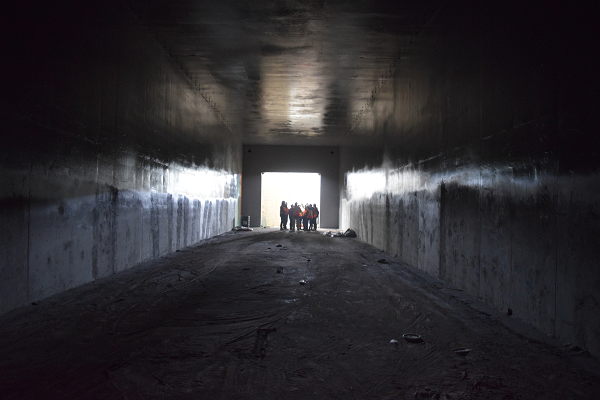
When operating, organic material is placed into one of eight long, 5m x 35m cells and inoculated with water that contains the necessary microbes for the digestion process. Over 28 days, the material breaks down and produces biogas, which is then sent to two 800 kW generators.


A view from inside one of the cells. It takes about eight hours to fill a single cell with organic waste.

The generators produce heat and electricity. The heat, about 90⁰C, will be used to dry the garbage fluff in the Integrated Processing and Transfer Facility(IPTF), which is then used as feedstock for Enerkem’s Waste-to-BiofuelsFacility. After losing some of its heat to the drying process, the air returns to the ADF at around 60⁰C -- the temperature ideal for anaerobic digestion -- and helps to heat the digestor cells.

Once the anaerobic digestion process is complete, the remaining material is moved into an aeration bay and mixed with carbon-rich green wood and further composted in an oxygen-rich environment over a period of 10 to 12 days.

Set to open in 2018, the Anaerobic Digester was built primarily to compost unmixed, organic material such as household food and yard waste. The electricity will be used to power the Edmonton Composting Facility (ECF). Waste Services will consider how to use this electricity when the ECF is not operating, depending on need.

Learn about the Edmonton Waste Management Centre.
Visit edmonton.ca/ewmc
Visit EWMC Interactive Site Map

Tim is an employee with Waste Services who completed the MCR Training in 2017. As a member of the Education Team, he leads tours of the Edmonton Waste Management Cenre and involves Grade Four students in managing their own waste.


Tuesday, October 31, 2017

Waste Services Temporarily Closes the Compost Facility

The City of Edmonton's Waste Services has temporarily closed the Edmonton Composting Facility (ECF).

An engineering assessment of the ECF identified structural issues with the building. As staff safety is the number one priority, Waste Services has temporarily shut down the composting facility while they explore short- and long-term solutions.
In the interim, wet waste will be redirected to the transfer floor. Waste Services is urgently working to find other options to best manage the organics fraction.

Tuesday, May 16, 2017

Don't Feed the Grass Monster


During the grass growing season (May - August), weekly residential waste can be monstrous, even double the volume collected during the winter. To avoid feeding the Grass Monster, the City is asking residents to go bagless this summer, and leave grass clippings on the lawn.

An average household that bags their clippings sets out 40 to 50 bags of grass each year. Roughly 30,000 tonnes of grass are collected annually, which is equivalent to the weight of 2,382 City buses.


Going bagless has many benefits:
  • It’s good for your lawn: the grass clippings protect the soil by keeping moisture in the ground. Also, the clippings break down quickly, naturally fertilizing the lawn with nutrients after each mowing.
  • It’s good for you: no bagging and dragging of grass is required, and it reduces the need to water and fertilize your lawn.
  • It’s good for the environment: in the summer months, up to half of the waste collected by the City is grass. Going bagless is the easiest, most effective way to reduce waste. 
More than half of Edmonton households already practice going bagless -- join them! By signing up for a Go Bagless lawn sign, you’ll have a chance to win a checkup and tuneup for your mower from the Lawnmower Hospital.

For more information visit edmonton.ca/GoBagless.

Wednesday, March 15, 2017

MCRs Tour Kennedale Eco Station


Almost forty MCRs (and MCRs-to-be!) and their friends braved an early-March snow storm to come for a tour of Kennedale Eco Station.

We were met by Andy, Hal and Chris, who showed us around, answered all of our questions and helped teach us what Edmontonians should know about coming to an Eco Station!

After a brief overview in the Kennedale lunch room, we bundled up against the cold and put on our safety gear. We then split up into three groups and got started!

Kathleen and Faical S. are two of our new 2017 volunteers! They're excited to start the MCR training.
Outside, we visited the entry kiosk and looked at some of the large bins, where things like scrap metal and lumber are collected. We also made a stop in the Reuse Area, where we chatted about what happens to still-usable items when they are dropped off at an Eco Station. With permission from the resident, those items are made available to others for reuse. We also chatted about the partnership between Eco Stations and the Reuse Centre, and the difference between the two different reuse opportunities.

Inside the main drop-off building, we learned a lot more about what Edmontonians can bring to an Eco Station, and how staff process those items.

Andy, Supervisor of Ambleside Eco Station, chats with his tour group about what happens when customers drive in with their items.
Eco Station staff are trained to accept and handle a wide variety of waste, including household chemicals. Cleaners, pest control products, motor oil, antifreeze and other potentially hazardous chemicals should never be thrown in the garbage or poured down the drain.

Motor oil can be dropped off at any Eco Station for free, and should never be placed in your regular garbage.
Staff place chemicals on labelled tables as customers drop them off, to avoid contamination and dangerous reactions. For this reason, Eco Stations ask that all chemicals be left in their original containers. This way, staff always know what they are dealing with.

Andy describes how chemicals are sorted by type.
For our safety, we were cautioned not to touch the tables or containers, as they might contain traces of corrosive or poisonous chemicals. Staff wear gloves, safety goggles, and protective Tyvex suits to keep safe while handling these items.

A drum full of household chemicals.
Chemicals of the same type are packaged together in large drums. When full, the drums will be sealed and shipped for processing elsewhere. Some chemicals can be recycled, while others are incinerated as hazardous waste at a facility in Swan Hills.

Hal, Supervisor of Kennedale Eco Station, opens up a drum of batteries.
Like other items, batteries are collected in drums and separated by type to avoid dangerous chemical interactions. This includes small household batteries, as well as the specialized batteries for laptops, cell phones and power tools. They will all be shipped to private companies for recycling. Different companies provide services for different types of batteries.

Cell phone batteries get removed, and the remaining hardware is collected in large, pallet-sized boxes. This one is about four feet tall, and about 3/4 full.
Some electronics like computers are kept in secure areas to protect personal information that might remain stored on the device. Televisions are put on pallets and wrapped for safe transport, while other small household electronics are stored in bins outside.

"White goods" like fridges, freezers and air conditioners can emit CFCs, or chlorofluorocarbons, into the atmosphere. This can be damaging to the ozone layer so these items are processed separately. Other large appliances are also collected.

All electronics collected at Eco Stations will be packaged and sent to Global Electric Electronic Processing (GEEP), a facility that is housed at the Edmonton Waste Management Centre. Employees working at GEEP dismantle all of the electronics and separate the various materials for recycling. They recover metals like gold, aluminum and copper, as well as other materials like plastic and glass.

Fluorescent bulbs are collected in large cardboard tubes to await processing.
Fluorescent bulbs are collected and run through a bulb crusher, which grinds up the glass and captures the mercury inside so it can be recycled or disposed of safely. All light bulbs, even those that don't contain mercury, should be taken to an Eco Station.
Chris, Lead Hand at Kennedale Eco Station, describes how the bulb crusher (pictured in the background) works.
Flourescent light ballasts are examined carefully before sorting. Old ballasts require special processing because they may contain polychlorinated biphynyls (PCBs), which are considered hazardous. Modern light ballasts are handled like other electronics.

This bag contains fluorescent light ballasts for special disposal.
After the tour, our three groups met back in the lunch room, where we were able to ask a few more questions, and chat with each other about what we had seen. Andy finished off our tour with his top tips to share for your next Eco Station visit:
  1. Do your research. Eco Stations accept a wide variety of items! Many customers arrive and are surprised by what they could have brought in.
  2. Handle your waste safely. Always keep chemicals in their original containers and never mix them. Transport chemicals in a sturdy box, rather than plastic bags, to reduce the chances of spills.
  3. Sort your material. Put chemicals together in one box, electronics in another and so on. This will make your visit quick and easy! 
  4. Be patient. Eco stations are popular so please allow for extra time during busy periods. Staff are working hard to serve residents as efficiently as possible!
  5. Start with the 3Rs at home! Many usable items are dropped off at Eco Stations. Save time, save money, and save the planet by limiting what you purchase, reusing the things you have, and donating items to others.
Thank you to everyone who joined us, and special thanks go out to Andy, Hal, and Chris for organizing and hosting our tour!

-Photographs provided by MCR program staff

Friday, January 27, 2017

MCRs Share Their Stories - 2016

MCRs share all kinds of awesome details about their volunteering when they record hours or provide feedback. Here are some quotes from MCRs in 2016 reaching their friends, neighbours and colleagues:
  • "I spoke to my landlord [and] she was hesitant, but also let me go ahead and grasscycle. I spoke to her about the benefits of it." - Zoila G.
  • “This was a good venue to be at. The people [we] talked with were quite open to hearing about what we were there for and it wasn’t very difficult to figure out what topic(s) they needed they needed information on.” - Joanne M.
  • "Helped set a friend up with a new backyard composter, introduced them to vermicomposting. Hopefully will set them up with a worm bin soon." - Natasha C.
  • “Had dinner with a coworker and her boyfriend and we talked about backyard composting (mainly) and about different myths and truths behind it.” - Amanda R.
  • "Talked with a neighbour in my crescent about needing leaves for my compost. Later that week he dropped off three bags of dry leaves!" - Angela F.
  • "Explained about having worms living in my closet and what they will be doing for me and my plants in the future." - Carolyn H.
  • "I presented to three kindergarten classes with my worm bin. The kids were very attentive and asked many questions." - Barb N.
  • "Did a presentation at the staff meeting at the school that I work at about good practices in recycling and ways to reduce waste within the school building." - Reinette E.
  • "We had my 7 year old son's birthday party at the Reuse Centre and were able to introduce that facility to several of our family and friends at that celebration. Many plan to come back to craft and shop there in the future." - Tammy F.
  • “Helped build a plan for an acquaintance moving to a new country so that she wouldn’t have to throw anything into the garbage unnecessarily.” - Leah A.
  • "Chatted with a lady at Costco who was looking at their double-tumbler composter and discussed the pros and cons of different types." - Rob B.
  • "Demonstrated the use of kitchen waste to set up a worm compost." - Andrew W.
  • “I am training bit-by-bit the MSW subcommittee at work to help steer the committee away from mis-informing the business regarding recycling.” - Kenneth R.
  • “I did an environmental moment at all 9 of my safety meetings about how our company uses City of Edmonton services to pick up our waste and how it gets processed.” - Lee W.

There were far too many great stories to display all of them in one post. Check back next week for more!

Tuesday, January 3, 2017

Holiday Waste: What Goes Where?

As you clean up from your holiday celebrations, it's important to do the right thing with your waste. Use these tips to sort your holiday waste, or check out our sorting app, WasteWise.


What can I reuse?
Consider donating unwanted items to a local thrift shop, charity or to the Reuse Centre.
  • Decorations
  • Wrapping paper and bows
  • Gift bags and boxes
  • Packing peanuts
  • Bubble wrap
  • Tissue paper
What goes in my household recycling?
Keep your recycling clean, loose, and dry for your blue bag or your apartment blue bin. Residents can also bring items to one of Edmonton's 20 community recycling depots.
  • Paper - wrapping paper (non-metallic), holiday cards, envelopes
  • Cardboard - shipping boxes, cardboard packaging, gift boxes
  • Plastic - shopping bags, pop bottles, containers (e.g. yogurt tubs, clamshell packages)
  • Metal - pop cans, aluminum pie plates, tin cans
  • Glass - beverage bottles, food jars
What about Eco Stations?
Some unwanted items contain hazardous materials or are difficult to recycle. Bring them to an Eco Station for free and safe disposal:
  • Strings of lights
  • Small appliances
  • Obsolete electronics
  • Old batteries
  • Household chemicals
Never put Eco Station items in your blue bag or garbage. Also take large items like furniture and major appliances to an Eco Station for proper disposal (fees apply).

What goes in the garbage?
Not everything can be recycled. Some holiday waste should go in the garbage.
  • Food waste
  • Styrofoam packaging
  • Soiled napkins and paper plates
  • Candy wrappers
  • Metallic gift wrap
  • Plastic cutlery
Check out more tips and tricks at edmonton.ca/wastelessholidays.

Download WasteWise for free on iTunes or Google Play, or use it online at edmonton.ca/waste

Wednesday, November 23, 2016

What Happens to Your TV?

Do you know what happens to your TV once you've taken it to an Eco Station?


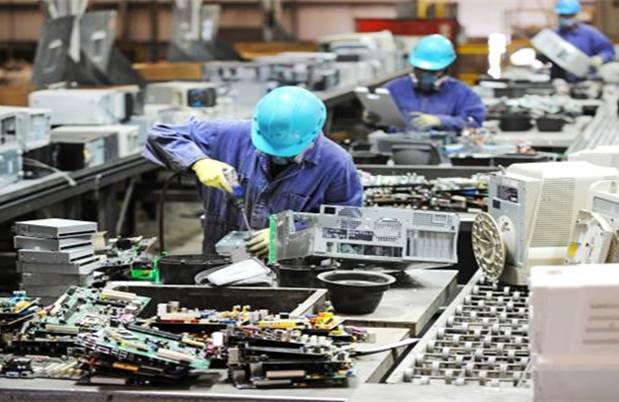
Televisions and other e-waste items are packaged and delivered to the Global Electric Electronic Processing (GEEP) at the Edmonton Waste Management Centre for recycling.


Workers at GEEP remove the plastic casing from around computer monitors and televisions. 


The yoke is removed from cathode ray tube (CRT) televisions and the copper wiring is taken out.


The tubes are removed and sent to a company that will separate and recycle the glass and lead.


Workers remove circuit boards and other components from televisions, monitors and computer cases. 


The circuit boards and other e-waste components are sent through a chain shredder where they are pulverized. This releases individual materials for recycling.


Ferrous metals like steel are separated out via an electromagnet. Non-ferrous metals like aluminum, brass, and copper are recovered by an eddy current separator.


Workers on a sorting line also help remove materials like motors, transformers, stainless steel parts, circuit boards, and mixed plastics. 


Shredded plastics are separated out and sorted using advanced machinery.


Recovered materials can then be used in the manufacture of new products. This reduces the need for plastics production and mining of precious metals. 

- Photos provided by the City of Edmonton


Monday, November 14, 2016

Businesses Invited to Tap into "Circular Economy"


Is your business keen to reduce waste and boost efficiency? Or close loops in production and tap into new markets?

Join the City of Edmonton, along with the National Zero Waste Council and the Recycling Council of Alberta for a business luncheon and learning opportunity. Prominent corporate social responsibility expert, Coro Strandberg, will share tips for incorporating circular approaches to business strategy, design innovation and stakeholder engagement. She will also share the National Zero Waste Council’s new Circular Economy Business Toolkit.

Date: Tuesday, November 15 , 2016 
Time: 11:45 a.m. to 1:30 p.m.  
Location:  Heritage Room, City Hall
Cost:Free of charge; Pre-registration required

Register to reserve your spot, as space is limited!

Wednesday, September 14, 2016

Musings of a Practicum Student

Photo provided by Linda
My name is Linda. I am a student from Campbell College, and I am currently near the end my practicum with the Master Composter Recyclers, Utility Services, City of Edmonton.

Image source: seourpicz

I have lived in Edmonton for three years now, and I honestly had very limited knowledge of waste management. While I was searching for a possible placement host for my Campbell College practicum, I saw a posting from the MCR program. I believed this would be a good experience for me, so I applied. When I came for an interview with Rodney and Sarah, Rodney asked me how I discard a used battery and I told him, “I throw it in the black bag with the rest of the garbage.”  Well, my answer was definitely not the right one, but this is one of the things I have learned.

I had a chance to tour the Edmonton Waste Management Centre, and it was a wonderful experience. I also went to see the Reuse Centre, and this too was an eye opener because I saw beautiful crafts made of supposedly garbage materials. All these experiences make me feel very proud to be part of a community that has the technology as well as the motivation to make sure that waste is reduced and managed properly.

I asked myself, “Why did I not see all these pieces of information before?” I realized it is because I did not take the time to learn anything about waste management. The information has always been available, and all I needed to do was search.

As part of my practicum, we are required to go back to school for two days to share our experiences and things that we have learned. I managed to talk a little bit about recycling and going bagless when mowing lawns. During my presentation, someone asked if pizza boxes are recyclable. There was a discussion and I knew the answer! I told them, “Pizza boxes are recyclable, depending on the amount of cheese and oil that stained the box.”

This experience showed me that people are actually very receptive to the idea of recycling. Even a little information can initiate responses, and it is how we respond to those queries or point people in the right direction that we can encourage them to engage in a deeper discussion.  This reminds me of our MCR volunteers, who are continuously dedicating time, energy, and effort to teach others about waste.

THANK YOU TO ALL OUR VOLUNTEERS!

I am indeed very grateful for the opportunity to work in this section because it gave me a different understanding on reducing, recycling, and reusing waste. My family has accepted the concept as well and we are now actually recycling. I truly believe that waste management plays a big role towards that goal, and being able to make a difference in the preservation of nature is a wonderful thing.
Image source: Keyword-suggestions.com


Wednesday, October 28, 2015

Turn Them In: A Successful Campaign

Edmonton's Kennedale Eco Station opened in the northeast of the city on March 31, 2015. With this addition, there is now one Eco Station in each quadrant of Edmonton. Visit edmonton.ca/EcoStations to find one in your area.

The opening provided a great opportunity to remind Edmontonians of what items to take to the Eco Stations and how to use them. We launched the Turn Them In campaign, which focused on the disposal of household hazardous waste. The campaign reminded residents that items like cleaning chemicals, batteries, motor oil, light bulbs, and paint should never go in the garbage, and that they are FREE to drop off at the Eco Stations.

In partnership with Global TV, the City of Edmonton challenged Edmontonians to reach 30,000 Eco Stations visits in 30 days. The challenge was a success, with 30,447 visits between April 11 and May 12! The new Kennedale site claimed a whopping 7,699 of those visits.

"Turn Them In" combined internet and television ads to get the word out, including this ad, which aired on several networks, such as Global, CityTV, and OMNI (plus some US channels through Shaw).


"Turn Them In: Hidden Horrors" won a Telly award for excellence in commercial videos and online content.

Our favourite new mascot, Battery Newman, also received a Telly Award for online content.


CityTV also produced a mini documentary about Eco Stations, called Eco City. It features interviews with several employees of Waste Management Services, who clear up some mysteries about what to take to an Eco Station and what happens once you Turn It In.


Overall, visits to Eco Stations increased by 20 per cent (compared to April and May, 2014). On a city-wide scale, that translates into a huge amount of waste diverted from the landfill.

Way to go, Edmonton!

Friday, September 11, 2015

The Amazing Race Canada... is on its way to Edmonton!


The Edmonton Waste Management Centre will be featured on the next episode of The Amazing Race Canada.

WMS Contract Administrator Clayton S. with host of The Amazing Race Canada, John Montgomery, at the Materials Recovery Facility.
Fans of the popular TV show will get a chance to see their favourite teams fight for their spot while looking for clues and finding their way through Edmonton in an episode airing on Thursday, September 17 at 8 p.m.

Competitors will face tough challenges which include choosing between a difficult task at the Materials Recovery Facility or the GEEP facility.

"It was a lot of fun helping develop the challenges," states WMS Contract Administrator Clayton Sampson. "They showcase the demanding and awesome work we perform on a daily basis at the EWMC."

For more information about the show please visit The Amazing Race website.

Wednesday, September 2, 2015

Celebrating Summer with MCRs

Thank you for joining us on August 18th for the MCR Summer Social:
"The Birds & the Bees.... and the EWMC."

One of our largest MCR socials in recent years!

60 volunteers and guests enjoyed stories about backyard chickens, beekeeping, and updates from the Edmonton Waste Management Centre.

Special thanks to MCRs Neil B., Rena C., and Jocelyn C. They had fun tales to tell.


Congratulations to several MCRs who have completed over 35 hours of MCR volunteering. They received books, certificates, and their official MCR name tags!

Welcome to the club. They join a distinguished group of Edmontonians.

Want to Learn More?
   
Check Out These Videos