Friday, December 1, 2017

The A,B,Cs of a Great Back Alley Display by MCR Patti D.

I live in an older area with neighbours who frequently walk their dogs through the back alleys.  My MCR personal project was to create a back alley display about waste reduction.  How hard can that be, I thought?
  • Go to the dollar store. 
  • Get a display board. 
  • Create signage about waste reduction. 
  • Put the signs in page protectors. 
  • Change the signs each week. 
  • Start conversations. 
Voila – my 35 volunteer MCR hours are filled in no time!
Challenge 1:  Rain.  The display board from the dollar store was not waterproof.  After the first heavy rain, it was destroyed. Although I must note that there were pieces remaining around the screws that I had used to attach the display board to the fence...
Solution:  I spent $5 more and purchased composite wood board from Home Depot.  The sales clerk assured me it should last at least 2 years.
Challenge 2:  Wind.  I placed the signs on the board one day and proudly went out the next morning to inspect them.  All the signs were missing. I later located all the signs down the alley.
Solution:  I stopped using thumb tacks and used heavy duty staples to tack the signs to the board.
Challenge 3:  Wind AND Rain:  I placed the signs in page protectors with the openings at the bottom – smart eh?  The rain will not move upwards!  Wind will actually move the rain upwards and the page protectors did not help against rain.  The beautifully coloured signs looked like runny rainbows displayed in plastic envelopes.

 I’m VERY pleased to report that once I decided to use quality products, my back alley display was in much better shape.  
Solution:  Ordered expensive self-laminating sheets from Staples.  All signs are laminated front and back before they are stapled to the composite wood board.
Challenge 4:  Procrastination.  I blame it on loss of momentum.  I spent three weeks working on solutions to the first three challenges. Once I got those sorted out, I found that my enthusiasm for this project diminished.  I found other stuff to do over the summer and my signs were NOT changed once a week.  
Solution:  There is no solution; I am a procrastinator.  Regardless, I’m very proud of the signs I have created to date AND -  now that I have worked out solutions - it’s a simple matter to create a new sign, laminate it and place it in my Back Alley Display.
Challenge 5:  Conversations.  This did not spark as many conversations as I’d hoped.  In my dreams, I had people coming up to me, eager to take in the knowledge that I had to give. I had one neighbour admit to me that she did not compost as if it was a dirty little secret. Another asked me to come by her place to discuss garbage versus composting. I had hoped for a lot more interaction.  
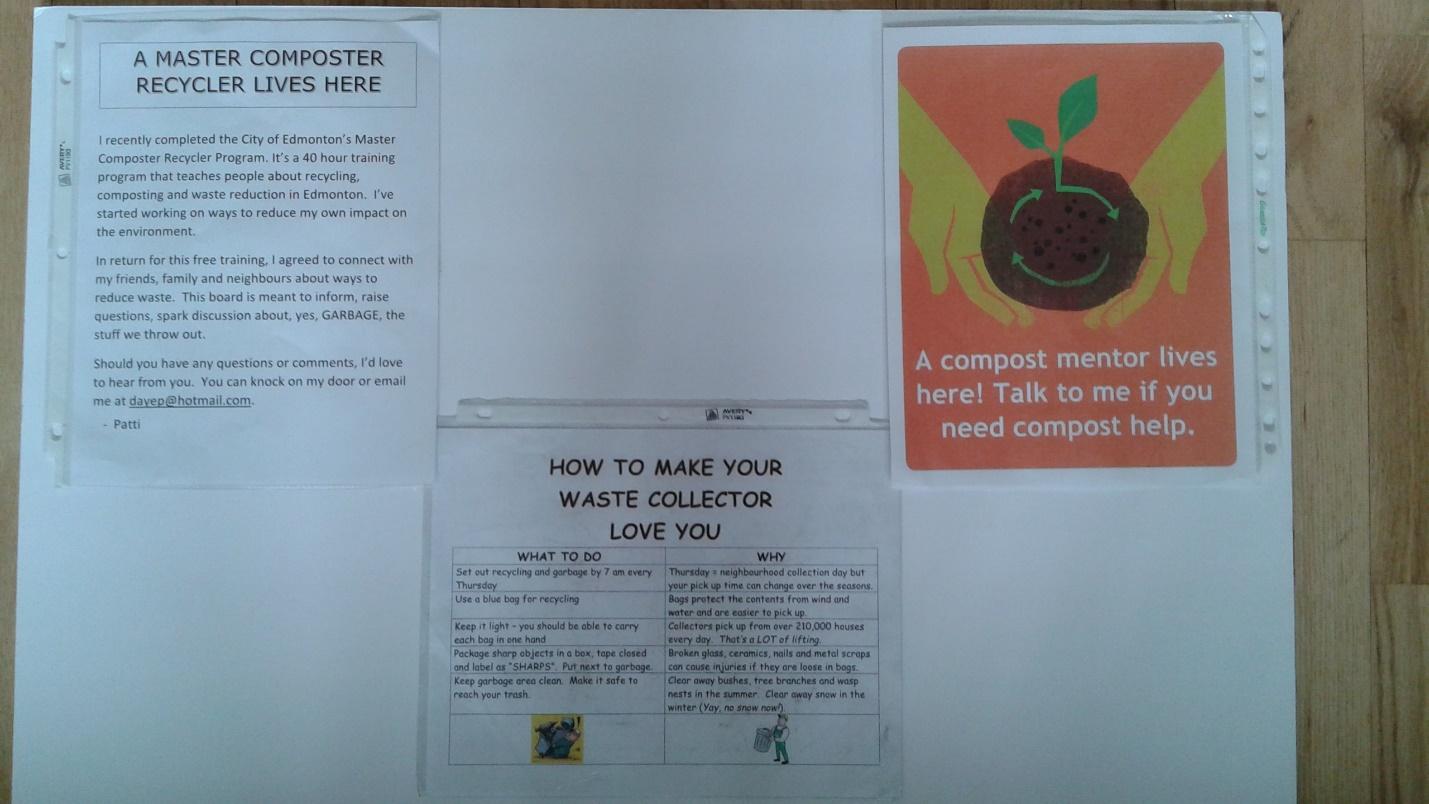
 A compost mentor lives here. Talk to me if you need compost help. 

Solution:
 The feedback I’ve received from other neighbours tells me that they ARE reading my signs; one neighbor walked by and I heard him explain to his son what grasscycling is.  Through the signs, people in my neighbourhood have started to think about waste reduction.  Here’s to my next six months!
---

Patti loves Edmonton and wants to help make it an even better place to live. She is now worm composting and started her first outdoor compost, this year. She has enjoyed sharing her knowledge with her neighbours at their annual block party. She keeps a box in her basement to store old batteries and light bulbs. When it's full, they take a trip to the Eco Station.



Thursday, November 16, 2017

Book Review by MCR Eve C. - Zero Waste Home

Image source: https://zerowastehome.com/about/book/
Zero Waste Home by Bea Johnson. Scribner: New York, 2013. Review by Eve C., MCR-in-training.

When you’re ready to take your waste reduction efforts to the next level, Zero Waste Home, Bea Johnson’s guide to no-waste living, will provide hundreds of pages of ideas.

As newbie MCRs-in-training, we began the program with a variety of levels of proficiency about minimizing the garbage that leaves our homes. Through the program, we learned the ins and outs of recycling, composting, waste collection, and reusing in Edmonton. We are now reaching out to friends, family, and neighbours to spread the word.

Although we are prepared to provide helpful information to those just starting on their waste  reduction journey, what about those who have mastered the basics? If you or someone you meet through your MCR volunteering wants to make a major shift in their life in order to eliminate waste, the approach taken by Bea Johnson may provide inspiration.

Johnson’s approach calls for a fundamental rethinking of how we view waste in our lives. Instead of the well-known Reduce-Reuse-Recycle mantra, Johnson helpfully urges much more proactivity with these 5 Rs:

Refuse what you do not need.
Reduce what you do need.
Reuse by using reusables.
Recycle what you cannot refuse, reduce, or reuse.
Rot (compost) the rest.

Her emphasis on Refuse struck me as a powerful technique for cutting down on the waste entering my home. I am planning to start rejecting swag at conferences, stores, and events; I always get home and wondered why I accepted a bag full of junk that I now have to get rid of.

I also distilled several tips that seem practical and relevant to my life:

       Using coloured pencils instead of highlighters (the pencil shavings will break down).

       Using French glass canning jars for storing leftovers in your fridge (the jars are quite affordable and attractive, and they display what is in your fridge so that you are less likely to forget about it).

       Put stickers on your waste containers (garbage, recycling, reuse, compost) to make it easy for you and guests to put things in the right places.

       Write the tare (weight) on your reusable containers when taking them to the store for bulk refills. Although Johnson uses glass jars for all her groceries, which is beyond what I would ever be interested in doing, I would like to try Bulk Barn’s program which allows you to bring your own jars.

       Downsize things you do not use as much, such as sporting goods and tools. Instead, consider using the Edmonton Tool Library, rentals, or sharing purchases among a group of friends, etc.


The Edmonton Tool Library
The Edmonton tool library opened this year to provide Edmontonians affordable access to tools. They are also always looking for donations.

Although I enjoyed this book, I would caution that it is best viewed as a collection of tips, from which each reader will inevitably find a few really good ideas to incorporate into their own life, rather than a cohesive vision of a new way to live for all but the most inspired. Johnson’s privileged standard of living, and her California location, may not necessarily translate to the average person.

The book also made me reflect on the Changing Waste Behaviours section of our MCR training, particularly the Benefits and Barriers section. She focuses a lot on cooking from scratch, with fresh local ingredients, using food products for bathing and makeup rather than conventional toiletry items, and removing items with certain chemicals from her home. This book seems likely to appeal to someone with a passion for DIY and an interest in avoiding chemicals in their daily life. The book seems very well-positioned to appeal to that demographic. It would be a helpful resource if your audience was motivated by these concerns.

The converse is that this book would not be well received by anyone who is approaching waste reduction from a more pragmatic and skeptical perspective. Many of her suggestions are not accurate, such as claiming that aluminum cookware will harm your health and should be replaced.[1]

Some of Johnson’s other tips seem unsafe - including making DIY eyeliner, using glass bottles in the shower, and using cheese as earplugs. Ideas like making all your soap from scratch, making your own paper, and growing your own loofahs seem to require an investment of time (and raw materials) that exceed the potential environmental benefits. Finally, tips such as refusing gifts from friends if they come in packaging, and trying to give out unpackaged Halloween candy, are more likely to alienate those around you than to motivate people to follow your example.

Nonetheless, even if Johnson’s trial and error attempts to arrive at zero waste are sometimes unsuccessful, her approach and passion for the topic is commendable. If you stick with the book, you will come away with some helpful ideas and a new eye for examining the waste you produce.

Postscript: Smart Waste Home in Edmonton

Most of us will likely never aim for or achieve a Zero Waste Home. However, the MCR program has set us up to create and help others with a Smart Waste Home –where all waste is correctly diverted into the most efficient and least environmentally harmful stream.

The Wastewise App is my favourite tool for being smart about waste. It reminds me about our collection day every week, and helps me be certain when someone asks me a question about sorting waste. It also takes away the decision fatigue of constantly making judgment calls about what goes where, which may lead some to give up entirely.

Overall, the practical and locally-targeted resources from the MCR program are an excellent foundation for recognizing that - for most of us - some waste is here to stay. We can use simple techniques to deal with it as effectively as possible. 

Borrow Zero Waste Home from the Edmonton Public Library.


Thursday, November 9, 2017

City Launches New Change for Climate Initiative for Edmontonians

The City of Edmonton has launched Change for Climate, a new initiative to encourage citizens to take action on climate change.


The initiative is anchored around a new blog called ChangeForClimate.ca where residents are provided a spectrum of 30 actions to help reduce their greenhouse gas emissions. The actions cover a wide range of impact levels, from hanging clothes instead of using a dryer to installing a solar panel system on a roof.

“Edmonton has emerged as a sustainability-focused city, and our citizens care about sustainability,” says Councillor Michael Walters. “Change for Climate will serve as a tool where citizens can learn and practice ways to reduce their carbon footprint. They will be provided with a real opportunity to act on climate change.”

The Change for Climate initiative is a major component of the City’s goal of creating a 35% reduction in the city’s greenhouse gas emissions by 2035 (below 2005 levels). The blog will provide Edmontonians with the opportunity to share their Change for Climate stories, highlighting why and how they are taking action. It also encourages citizens to select actions from the spectrum, participate on related City programs and share their commitments on social media.

Edmonton is part of global social, economic and environmental systems that support our quality of life. These systems are being disrupted by climate change. We have an opportunity to act now and act locally to protect our quality of life, our health and our economy. Our actions in our community have local and global impacts.

Edmontonians will have many opportunities to engage and participate in the new Change for Climate initiative. Over the next six months, various community events will take place starting with Change for Climate Talks on Dec.7, an evening in which 12 speakers will bring fast paced and inspiring presentations on what we can do to act on climate change. More events are planned in the New Year leading up to the 2018 Cities and Climate Change Science Conference March 5-7.

Visit ChangeForClimate.ca

Monday, November 6, 2017

Tell One Friend: Apply to be a Master Composter Recycler


The MCR program is looking for the next great community leaders in waste reduction. Training starts in 2018. Apply now!

  • Does your neighbour ask about your compost pile?
  • Who is that one friend who loves talking about recycling?
  • Is your coworker a great communicator and passionate about sustainability?

Tell them to apply.
Visit edmonton.ca/mcrp


Give Feedback

I have seen you sorting your waste. And we have chatted about Edmonton's waste system, a few times.

I felt the same way before I became a Master Composter Recycler.
Can I tell you a little about what I have learned?

Prompt Them: Plant the Seed

You would be a great role model for your community. Would you like to be an undercover agent for waste reduction?

MCRs volunteer in many ways. Most of all, we are waste reduction advocates for our friends and neighbours. Can I tell you some of the things that I that I've done as a volunteer?

One Small Ask 

Will you check out the Master Composter Recycler program? Just visit edmonton.ca/mcrp.

If you have other questions, you can ask me.
And if I do not have an answer, I will connect you with the organizers.

Thursday, November 2, 2017

Only YOU Can Prevent Dutch Elm Disease

Did you know Edmonton is home to one of the world’s largest concentrations of elm trees uninfected with Dutch elm disease?

Prevention of Dutch elm disease starts by keeping elm trees healthy. During the colder months (October 1 to March 31), prune dead wood from your elm trees. Dead wood is a habitat for the insect that causes Dutch elm disease. (The City is responsible for pruning and maintaining trees on boulevards.) It is illegal to prune between April 1 and September 30.

To Safely Dispose of Elm Wood:

  • Small elm branches can be bundled and placed at the curb with regular household waste. Bundles must be smaller than 1.2 m (4 ft) and 20 kg (44 lbs).
  • Large elm branches and logs can be taken to special elm disposal bins at an Eco StationDrop off is free. Branches must be smaller than 1.2m (4 ft) in order to fit the bins.
  • Large loads (more than a half-ton truck) and commercial loads must be taken to the Edmonton Waste Management CentreDisposal fees apply.
Do not to store wood from fallen or damaged trees, as this increases the risk of spreading Dutch elm and other tree diseases. Fallen trees on private property should be removed by a professional tree removal company. Do not keep or transport fallen elm tree debris for firewood.

Identifying Elm Trees

The elm tree has the following characteristics:


  • Green, toothed leaves that turn yellow in fall;
  • Bark that is deeply ridged and grey-brown in color;
  • A roughly vase- or fountain-like shape;
  • A height of about 35 metres (115 feet) and trunk diameter of about 175 centimetres (68 inches) at maturity.