Showing posts with label garden. Show all posts

Monday, August 26, 2019

Cover Crops: Part I

If your goal is healthy food, then your veggie patch needs cover crops.
They are part of a more natural approach to growing food.

Microbes in the soil provide nutrients to your plants. If soil runs out of microbes then plants don't get as many nutrients as they could with the help of a healthy food web. Ensure the life in your soil has what it needs to thrive.


Some easy ways to get started:

Peas

Early planting of peas will be the first crop to brown off. Right after the first picking, plant oats. They will fill in fast and won't interfere when pulling the vines off their supports and lay them on the soil as residue. You can start a flat of spinach in late July and transplant them into the open spaces, just drop them right into the pea residues. Careful not to pull out the roots.

Salad Greens

Greens don't take much from soil, so you can constantly plant more seeds throughout the summer. As we move into August, planting wheat will support soil fungi. Later in the month, planting daikon or tillage radish will further support the soil.

Garlic

Harvest begins in July when scapes (slender white pods of bulbils) are ready and leaf tips start to brown off. If browning off occurs in July, it's a sign that your soil is poorly drained. Lift bulbs in poor health and plant oats. As you lift single bulbs, stick in a fava bean. When the rest of the crop is lifted, plant radish, Johnny Jump-up, or Stinkweed.

Beans

Spacing around bush beans is wide enough to try a variety of cover crops. You can stick in a few species of soil builders or food crops as soon as harvest begins in July. It's an opportunity to use up left-over seeds here and there and see if you get a later harvest (avoid big plants like squash). It's also an opportunity to build resources into your soil for next year. If you plan to grown corn in that spot next year, then plant Alfalfa and Buckwheat, or if you plant a root crop, then go with annual grasses like wheat and barley. The beauty of the combinations will surprise and delight you.
Don't forget to cover the bed with leaves in October.


Friday, May 11, 2018

Gifts from the Compost Heap by MCR Maria K.

Republished thanks to Simple Moodlings (October, 2014). Thank you, Maria.


Besides giving me lots of great additive for our heavy clay-based soil, our compost pile gave me four other wonderful gifts this fall...
There were probably a dozen tomato seedlings growing on the top of my half-finished compost bin, so I dug four up and brought them into the greenhouse at the beginning of September (just before that first frosty snowfall on September 8th). Here's what they look like today...
A bit sparse and spindly, but there's fruit on those vines. As the sun is getting weaker by the day, this experiment might only give us a few tomatoes, as there will come a point when heating the greenhouse might seem a bit silly, and I'm not sure bringing these plants into the house will help much as our triple-paned energy efficient windows block out valuable rays. I think most of these are heirloom cherry tomatoes, so it's not like we'll get a big feed regardless, but it's fun to try. 

In the meantime, I'm plugging the benefits of composting to anyone who will listen, and borrowing leaves from family, friends and neighbours for next year's composting (we go through at least 20 big bags of leaves per year, if not more -- I always forget to count!) This year's compost is pretty much used up -- I dug a lot into the garden boxes on Tuesday, and yesterday and today I planted compost with my 113 tulip bulbs. It's nice to know that they have a good start in their compost/soil mix. I can't explain how good it feels to remediate my soil with the good black stuff I worked on making most of the summer. Way better than any chemical fertilizer money can buy!


If you like the idea of composting, but aren't sure how, there are likely books at your public library, or courses in your community. Failing that, feel free to leave a message below and I'll get back to you!

Visit edmonton.ca/compost

https://blogger.googleusercontent.com/img/b/R29vZ2xl/AVvXsEi0rpOkCnkGfFwWsKzxYRp1u6fVQRuft73SmKLoed6h0dNLiude6Bi5-WzQuMpXrX7T32MByJyr76Jj452VB_oa7aQbvaT-b5J24HGz2kKaFU0424ouQndXobRm8H4HkMBeJU9mMvtM1ok/s1600/Maria+K+for+blog.jpgMaria K. is an MCR who is all about living simply, reducing consumption and waste, gardening, and feeding the soil we depend on for good food. She has more Simple Suggestions at simplemoodlings.blogspot.ca.


Wednesday, March 7, 2018

Time to Save Your Eggshells by MCR Maria K.

As an avid gardener and Master Composter Recycler (class of 2007), I’ve learned a lot of wonderful garden tips that have helped to reduce the work of our City’s waste collectors. Here’s a small and simple trick, one of my favourites, that I employ every year, all year long, and it’s really easy!


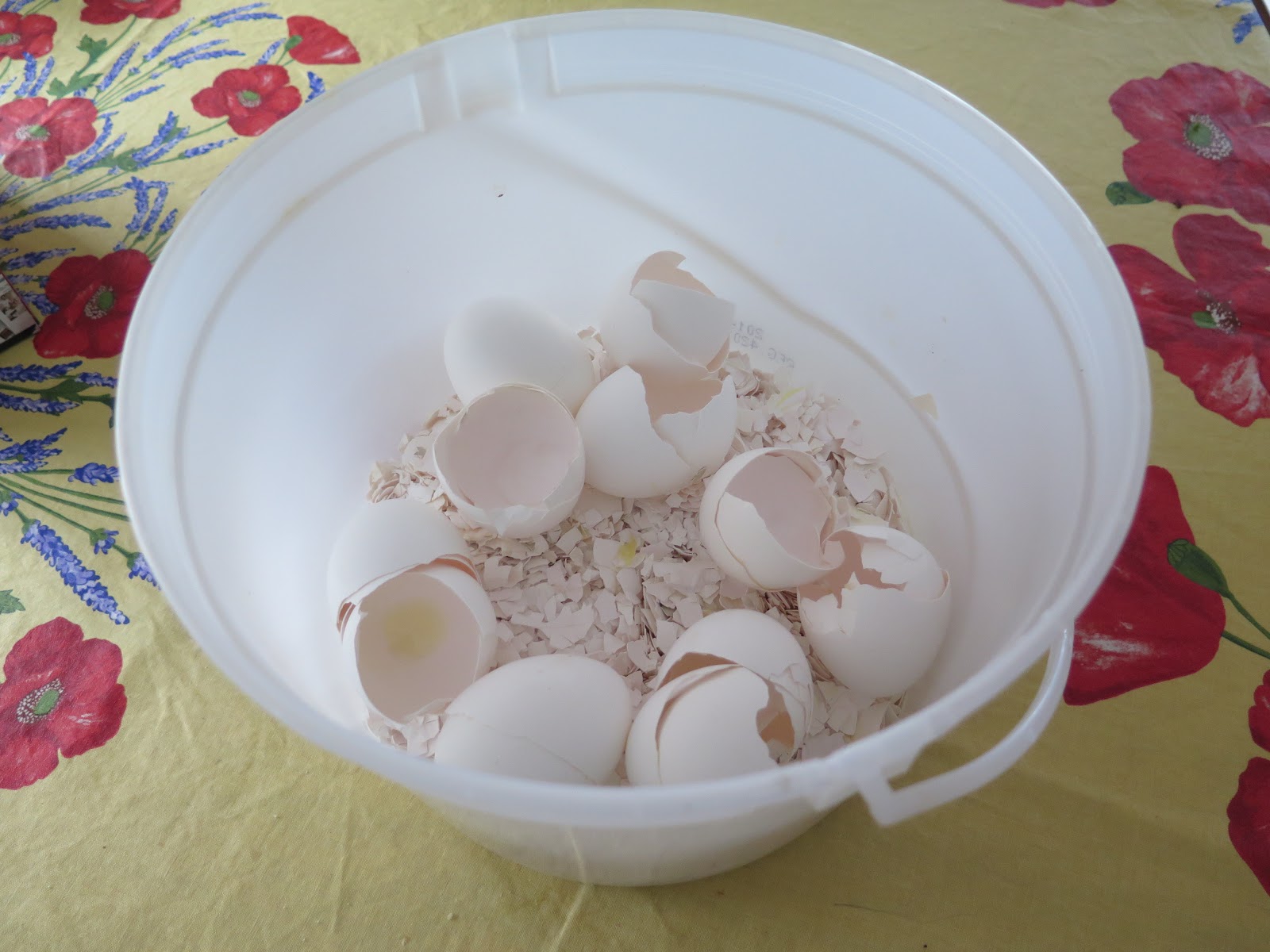
There’s an ice cream pail under my kitchen sink, all year, for eggshells. Why? Because they are an excellent mineral resource and slug discourager. I don’t even bother to wash them because I find they dry out in the pail. When my pail gets full, I take a potato masher and mash them down so that I can add more. By spring planting, I usually have a pail or two that are at least three-quarters full. (My family likes eggs, what can I say?)

Eggshells have nice sharp edges, so I use them pretty liberally wherever I plant lettuce and other veggies that slugs consider tender vittles. Basically, I plant the seeds in the soil, and cover the seed bed with eggshells, and the plants find their way through, no problem. In a few weeks, it looks quite pretty, eggshells with greens.

Tomato plants, in particular, really appreciate the calcium from mashed eggshells. I try to keep some on hand at all times and use a few hand-fulls wherever I see slug trails in my yard. You could say my slug population has really decreased over the last ten years!

And here’s a little bonus tip: When you get your hair cut, ask for the trimmings. Turns out hair is a nice source of slow-release nitrogen – another favourite snack of most plants.

Why give away eggshells and hair clippings (pet fur, too) when they are great resources for growing things?

Even if you’re not a gardener, chances are that you know someone who is. Offering them your eggshells is a great conversation starter about waste reduction. Why not try it?

Visit edmonton.ca/compost


https://blogger.googleusercontent.com/img/b/R29vZ2xl/AVvXsEi0rpOkCnkGfFwWsKzxYRp1u6fVQRuft73SmKLoed6h0dNLiude6Bi5-WzQuMpXrX7T32MByJyr76Jj452VB_oa7aQbvaT-b5J24HGz2kKaFU0424ouQndXobRm8H4HkMBeJU9mMvtM1ok/s1600/Maria+K+for+blog.jpgMaria K. is an MCR who is all about living simply, reducing consumption and waste, gardening, and feeding the soil we depend on for good food. She has more Simple Suggestions at simplemoodlings.blogspot.ca.


Friday, May 5, 2017

Tell One Friend: Use Your Compost!

Image provided by the City of Edmonton

Tell One Friend: Use your compost!

Now that spring has finally hit our fair city (knock on wood!), it's the perfect time to start using your finished compost. Your yard and garden will benefit from the burst of life and nutrients at the outset of the growing season.

Dig compost into your garden soil, sprinkle it over your lawn, or make a compost tea to nourish the soil in containers and houseplants.

Learn how at edmonton.ca/compost.


Use these ideas to remind your friends, family and co-workers:

Change habits
"Spring is a great time to use compost. It will get your growing season off to a healthy start."

Prompt them
"Let's look at your compost bin. You probably have some finished compost at the bottom."

One small ask
"Will you use some compost this spring?"


Visit edmonton.ca/reusecentre for more about the Reuse Centre.
Next Tell One Friend: Go Bagless this Summer! Previous Tell One Friend: Eco Station Summer Hours


Wednesday, April 1, 2015

Raised Garden Beds for $5 Each...Plus Labour - by MCR Sarah D.

Last summer I knew I wanted to convert some of my expansive front lawn to gardens. Being an admittedly lazy person when it comes to gardening (and given my late start to the season) I didn't want to rototill my front yard into rows to make this happen. Instead I turned to what I had recently learned from my participation in the City of Edmonton’s Master Composter Recycler (MCR) program.
A gorgeous example of reuse in action
In the MCR program, I learned about Habitat for Humanity’s ReStore in North Edmonton and the abundance of construction materials that could be found there. Not knowing what to expect, I took the trip over to the store to check it out. Upon arriving I noticed the remnants of window packaging in the front industrial yard – wood frames with cross beams casually labeled $5 each in sharpie. I immediately saw what these misshapen old frames could become. Just in case they'd already sold, I tried not to get too excited at my exquisite find.

Can you see where I'm going with this?
I pretended to ignore them, heart racing, and casually walked inside and up to the front counter. Trying to act natural I asked the clerk if I could purchase the empty window shipping crates and was over-joyed to discover I was not too late! We purchased 7 of them and had to make several trips back and forth to get them home – safety first. As you can imagine, making sure that each load was secure with straps and bungee cords was no small task.  It turned out I was extra lucky; we found out afterward that they could’ve sold them several times over later that day!

Once home I laid the frames out on the front lawn. This process for me took some time as I tried to think of the best way to use them. I went through a few patterns by placing and replacing them, and even sketching layouts that I liked on paper. I eventually found the design that would make the best use of the chain link fence and the position of the sun as it hits my yard.
Perfect place by the fence, and another bed in the middle of the yard
At first I thought about removing all the grass from the bottom of wherever I placed them, but quickly abandoned this notion in favour of something far easier. I decided to use old cardboard and newspapers to line the bottom of my new garden beds to ensure that the lawn below would not grow up through the soil. First, the kids and I removed some of the cross beams that would get in the way of roots and that didn’t really add a lot of structural integrity.

In order to make these garden beds as reuse friendly as possible, I collected some unfinished compost from my compost pile that had settled over the previous winter. I lined some of the beds with it and some without. If you don’t have any finished compost, unfinished will do in this case or you can purchase some compost through the City of Edmonton’s list of compost retailers.

Adding unfinished compost
Then I topped all the beds with soil I had purchased to fill the remaining volume, and voila! Raised garden beds for $5 plus labour and a little soil. All other materials were free/recycled!
Soon to be the envy of the neighbourhood
That first year we planted our veggies and had a great crop of onions, beets, carrots and basil and other fresh herbs. Truly a reuse success!

Life doesn't get any better than this!
___

Sarah became a Master Composter Recycler in May, 2014. She is passionate about reducing waste, both in her own life and the lives of others. She enjoys being a volunteer and helping to build a sense of community in Edmonton - making connections with like-minded people and learning fromt he wisdom and experiences of others.
"I especially like volunteering for events as sharing information I believe in, and am passionate about, gets me fired up!"

Monday, May 6, 2013

Edmonton Composts: Celebrating Compost Awareness Week May 5-12, 2013

Celebrate by telling someone how much you love composting or by helping them start composting! Composting is simple and has many benefits to you, your city, and your yard. 
Visit the Compost Demonstration Site at John Janzen Nature Centre to check out your options. There are many approaches to composting so find one that works with your lifestyle.  

You can compost indoors with Red Wriggler Worms like MCR Duncan K.
Once you have a compost, find a container for your kitchen scraps.
Keep a balance of green, browns, water, and air in your compost bin.
Compost bins like this one being harvested by MCRs Sarah F and Genia R can be purchased for $35 after taking a workshop.
Use compost to add nutrients to your lawn.

Which lawn do you think was treated with compost?
Add compost to your potted plants as fertilizer. 
Use compost in your garden, it will help the soil hold moisture and reduce compaction. Composting can be a fun and active activity to do with the family. 
Get creative with your compost! 

For Compost Awareness Week, The City of Edmonton is hosting 4 workshops at the John Janzen Nature Centre:
  • Tuesday, May 7 from 7-9pm
  • Wednesday, May 8 from 7-9pm
  • Thursday, May 9 from 7-9pm
  • Saturday, May 11 from 2-4pm
Classes are only $10 and you can purchase a composter for $35 after taking the workshop. Take a workshop to get started: register for a workshop